Monday, February 6, 2012

The Diamond Queen? Let's think about that...

Yes, it's the Queen's sixtieth anniversary as monarch of the UK and head of state of a bunch of other former colonies. Wonderful.

Before I go on, I should say this as a disclaimer: I have nothing against the Queen as a person. As far as I see, she seems like a nice woman, overall. True, it's been said that she cordially detested Diana after her divorce with Charles, and the way she initially dealt with Diana's death made much of the public question their loyalty to her person, but no-one's perfect. Queen Victoria, after the death of her husband, Albert, was not seen in public for something like thirty years. Thirty years! That's like if Elizabeth's husband, Philip, had died in, say 1970, and she stayed out of sight in Balmoral till the turn of the millenium. No wonder that the calls for the abolition of the monarchy reached their height during the middle of Victoria's long years of isolation.

No, the point of what I am saying is not to defame the Queen or the monarchy as a whole. In general, I'm a constitutional agnostic: I'm indifferent to if the head of state is elected or born to rule, so long as the government is democratic. What I'm objecting to is the sickly-sweet, gushy, pseudo-hagiographic portrayals of the Queen by the media. She's not a saint, or a national treasure, really: she's just a person who's had a very specific upbringing.
Yes, the Queen has been there for sixty years; yes, she has been, to paraphrase the media "the stalwart of British values and continuity through decades of unprecedented social and technological change" - but come on! So, by that definition, has practically any person over the age of seventy.
Any person who grew up during the Second World War can say the same thing, and, moreso can any person who actually fought for the country during those "darkest hours". I respect the Queen as much as I respect any person who has done something for the sake of others; but it would be much more fitting for the media to, rather than glorify "The Diamond Queen", better to celebrate "The Diamond Generation" - the generation that fought for the survival of Britain and (what was then) the Empire.

The Queen is now well into her eighties. That age, and the anachronism of her values, were starkly exposed with the death of Diana; she was seen to be out of touch, not realising that the idea of "stiff upper lip" had been slowly growing out of fashion for years. It took the midas touch of Tony Blair to carefully point her in the right direction, and show a public human side that did not come instinctively. That must have been a real eye-opener for the Queen at the time; for a monarch that had known nine Prime Ministers to be outshone by a fortysomething political newcomer.
Yes, the Queen has been through a lot in her life. Her younger sister, Margaret, was often stealing the limelight with her with her larger-than-life charisma and relationships. Yes, if Margaret had been the elder sister, the monarchy would rarely have seemed dull to the public. Margaret shared her charisma and love for the risque with her uncle, Edward VIII, and her great-grandfather, Edward VII. Margaret was also like her mother, the forever-popular and charismatic Queen Mother; Elizabeth, however, was her father's daughter.
If one was being unkind, where the media uses euphemisms as "a reign of assured stability", you could say that the Queen's long reign has been pretty dull compared to some previous monarchs. But I am not unkind: any monarch's reign mostly depends on the personality of the monarch, and the Queen has from the start of the reign made it clear that she sees her role as maintaining a sort of symbolic rock of understated but secure British values.

In terms of values, it can fairly be argued that the Queen no longer "represents British values", as Britain has not just socially progressed, but has been socially transformed almost beyond recognition from 1952, when Elizabeth Windsor became Queen. Not only is she one of the longest-reigning monarchs of the UK, but she has been monarch through a time of unprecedented social change (and I say this even though I realise am repeating the same sickly-sweet phrases the media use). By that definition, there is an argument for saying that the Queen should abdicate in favour of someone more suited to reflect British values as they stand in 2012 rather than in 1952.
But that would be to misunderstand the Queen's temperament. She is not the kind of person to abdicate for sake of convenience; for her, it is a lifelong commitment that she made upon her coronation. If that means she is still Queen come 2020 and beyond, then so be it.

That's what it means to have a monarchy: a monarch is for life, not just for Christmas.

Saturday, February 4, 2012

Your Will Is Not Your Own: why intelligence is linked to free thought

I recently read a Daily Mail article that talked about Canadian study linking prejudice and conservative thinking with people that have had lower intellectual capabilities as a child, here.

Am I surprised by the link? No, not really. It doesn't take a genius to work out that reactionary politics is a draw for those who look for simplistic explanations and easy solutions.

For an obvious example, there is a reason why the left-wing is more sympathetic towards the unemployed that the right. Norman Tebbitt, the infamous vanguard of the Thatcherite right, said that unemployed people were lazy; they didn't have a job because they couldn't be bothered looking for one, his own father, when out of work "got on his bike and looked for a job".
Clearly, life is more complex than that. While it's true that there are always a small percentage of people who genuinely are work-idle, the vast majority are unemployed due to a wide number of social and economic factors. People who are left-wing tend to see this; people on the right, often don't.
The same thinking goes for poverty: the left-wing cites the huge number of social and economic factors involved that can create and exacurbate poverty; the right may well just as well say people are poor because they lack the motivation to better themselves.
I could go on. Immigration is another famous example. The conservative right claims that immigrants take away jobs that would normally be available to natives; forgetting the fact that most immigrants do the jobs that natives usually don't want to do. This is true in Dublin and Doncaster as much as it is in Dubai. Again, while there may be a small proportion who are there to milk the generous benefits of living in civilised society, the vast majority start from the bottom rung, and only make any progress through working far harder and in far worse conditions than the natives. Immigrant-bashing from the right is not only wrong-headed, it's also immoral.

What is evidently true is that it's only by looking at any issue with the complete range of factors that a rational answer can be arrived at. This is what the scientific study mentioned in the Daily Mail is getting at: rationalism and free-thought (rather than prejudice and narrow-mindedness) go hand in hand with intelligence. Anyone bringing easy answers to complicated issues is using either lazy thinking or, bluntly, missing something in the head.

Does that mean that Karl Marx was smarter than, say, Ayn Rand? Well, there's a convincing argument that relying on simplistic models of society and human nature, as Ayn Rand does when arguing in favour of a complete free market, is not backed up by any real evidence. Whenever Rand's ideas were put into place, they tended to result in the opposite of what she intended.
Am I saying that Communism is therefore intellectually better than Capitalism? Communists certainly believed they were, and when the Soviet Union existed, those in power in Moscow (at least, at the start) believed that they were involved in some kind of quasi-scientific venture.
What went wrong with Communism is that it forgot that people by nature want to have free-will. That was one reason why Capitalism, for all its faults, was ultimately more successful: the attraction of free-will, over the will of the state, won the day.
However, the Great Crash of 2008 brought the flaws of Capitalism into sharp focus; nowadays, people would rather the state have a bigger role in society; they would rather sacrifice some of their "free-will" in order to ensure stability in society as a whole. That demonstrates the fact that many people understand that life is not an "either-or" choice; life is complicated and messy, and that's why there needs to be a middle ground between the things that individuals do best, and the things that government can do best. Few people these days would agree with Ronald Reagan that "government is the problem". In that sense, people nowadays are more left-wing than they were, say, thirty years ago: they recognise much better, and in much greater detail, what things individuals do well, and what things government should be responsible for.

This issue of free-will doesn't only apply to politics. Although I am not openly religious (I have stated on my Facebook page that I am a Stoic Pantheist), the issue of free-will and religion can't be avoided while we're on the topic. Just as some right-wing people prefer the certainty that simple answers give (which also allows them to abrogate their thinking to those in power), people who are religiously conservative prefer the simple answers that their divine texts give.

Therefore, by definition, people who blindly rely on a religious text, without using their own minds to decide if it is something justifiable, cannot be considered rational or intelligent. Those who willingly choose to throw away their free-will to a religious text without question, are implicitly admitting to their own intellectual emptiness.

Some people, however, explain their conservative habits through national "culture"; a catch-all word that can be used to excuse the most abhorrent human behaviour, as well as an excuse for those already of weak mind and evil intent, to carry out their moral depravity.
There are many possible examples I could cite. The example in Pakistan, of a TV show host harassing young couples in a park to check if they are married, is relatively mild one. In Azerbaijan, journalists throwing false allegations at a pop star in a live question-and-answer session, is another. In Croatia, young couples may also be harassed by locals if they are suspected of not being married. In the USA, doctors who carry out abortions can be killed.

So what I am saying does not necessarily depend on the religion itself; it depends on the extent to which people decide to use religion or "culture" to pursue their own prejudices and ignorance. It is perfectly possible to be rational and free-thinking, and religious; a good example I saw recently was the conduct of the Amish people in rural USA, who follow the Bible more closely than the conservative fanatics, but with none of the blind ignorance and fervour. The Amish can calmly and rationally explain why sex after marriage is a good idea; the Taliban cannot. The Amish can calmly and rationally explain why their men and women wear the old-fashioned clothes they do; the Wahhabists cannot.

Your will is your own. To rely on one simple answer for everything, whether it be from "culture", a religious text, a one-size-fits-all solution, or a knee-jerk reaction, is demeaning to your own intelligence and humanity.


Friday, January 27, 2012

The Benefit Cap and Britain's "Benefit Cheats"

The UK government, and David Cameron in particular, have hit on an idea that would help reduce welfare and also be popular with the public. The idea to cap welfare benefits per family at no more than the national average income (around £25,000) seems suddenly to make great common sense to the government and a lot of people.

Except that the House of Lords loathe the idea and have blocked it. And suddenly government are asking what right they upper house have to block the democratically-elected parliament from carrying-out its programme.

Now might be a good time to step back and look at the underlying issues behind the "cap", why it would even be necessary for a family to need £25,000 in government subsidies, and why there is an outcry over "benefit cheats".

First things first: how are an unemployed family able to be given a government subsidy worth the average national income of a working person?
The simple answer is because that sum of money applies mostly to large unemployed families in the London area: more than half of that "subsidy" goes on rent; much of the rest on bills; leaving a pretty modest amount if you have two parents and five children. Don't forget, that's seven people living in one of the most expensive cities in the world. If they lived in, say, Middlesbrough, where rent is a fraction the price in London, then naturally they would get a lower subsidy.

The government, in its enthusiam to grab a headline (no change there, then), forgets to mention that the benefits a family receive are means-tested; it depends on the cost of living of the place in the UK you live. So the idea of a national "cap" is not only wrong-headed, it's also absurd. It means that unemployed familes with several children that live in London (who anyway would face a tiny number of flats big enough to house them), would be forced to move out of London entirely. In other words, forced clearances of large families from the capital.

But that's only the tip of the iceberg. What the issue of the "benefit cap" really highlights is the shocking cost of living in the UK, especially in London. That's the real scandal.

Yes, the real scandal is that due to the insanely high cost of rent in places like London and the South East, in order to prevent masses large unemployed familes from having to live on the street, the government has to fork out a subsidy worth a working person's average national income. That's no fault of the unemployed family; that's the fault of the shameless and unregulated landlords, who the government completely fail to control.

That in itself is an appalling indictment of the state of the insanely-inflated property market in the UK, in London in particular. Let's remind ourselves that the price of rent nationally is still going up; utility bills are going up; and the cost of everyday living is still going up. Meanwhile, wages remain stagnant. The result: people in the UK are getting deeper and deeper into real and virtual poverty.
In this kind of economy, many young people find it impossible to save money to buy a house. Meanwhile, almost zero interest rates give no incentive to save what little money they have in any case. Banks are reluctant to risk giving people with no savings a loan to make any possible investments. And year on year, costs keep going up while wages remain flat, meaning that annually the average person may well be five per cent (or more) poorer than the previous year. This is a slow-motion downward spiral to poverty on a national scale.

Well, thank god we have a welfare state. But the outcry against "benefit cheats" is also largely missing the point. Let's use a hypothetical example.
A worker who lives in the south-east has a job that makes £20,000. After deductions for tax and national insurance, that takes away upto 15% of his income at least. Then there's the rent, which hacks off another 40% of his income (if he's lucky) . Then there are bills, which takes off another 10%, leaving him with only 35% of his salary left. Oh, and if he has a car, there's insurance, road tax and fuel (say another 10% of his annual salary at least). So, in reality, what he has to survive on per year (for food and enterainment) may, in theory be around £5,000 per year. Divide that into fifty-two, and you have under £100 per week - to pay for everything else.

However, if you are unemployed, you qualify for JSA (around £70 per week), and the council helps to pay for your rent. This is obvious; unless the government expects people to become homeless soon after becoming unemployed. There are other things, like being able to qualify for free college education in many cases, in order to give an incentive for you to re-train and have a chance of getting a better job. All well and good, as you would hope for in a civilised country.

So this poses the problem: that many people who earn less than the average national salary would feel justified in being envious of the unemployed, who have much less to "worry about" - such as paying the rent and bills. Clearly there are many cases of people defrauding the government out of welfare, but it's not the majority by any means; and in any case, it's difficult to imagine the situation being done in a different way that would not destroy the moral fabric of our "civilised" society.
No, the main reason for this insane state of affairs is the scandalous (and to my mind, economically inexplicable) cost of rent and housing in the UK, as well as the added factors of increasing cost of living. The latter, I understand, is partly down to global factors somewhat out of the government's hands, but the price of property is something that the government could easily regulate, if it ever had the guts. Or at least find the core causes of the problem, and deal with it.

In the UK, then, the insane cost of property is one of the real factors that explain the call for the "benefit cap" and the envy that working people feel towards the unemployed.

So far, few people have made this link known to the government, sadly.

Thursday, January 26, 2012

How the UK became an anachronism

The UK (or to give it its full title, "The United Kingdom of Great Britain and Northern Ireland") is in trouble.

As I recently wrote, and as it's often in the news, Scotland is planning to decide on its constitutional marriage arrangements with its southern neighbour. Either divorce (independence) a marriage of convenience (devo-max), or to retain the current awkward arrangements.

If Scotland did choose independence, the "UK" by definition, would no longer exist - because there would no longer be a "United Kingdom of Great Britain and Northern Ireland"; just a Kingdom of England, Wales and Northern Ireland. It's Scotland that gives Britain the name "Great".
It seems extraordinary (ignorant as well as arrogant) that Westminster politicians have not realised what "The UK" is: a legal union of two states, England (with Wales and Northern Ireland), and Scotland. Westminster seems to think that it carry on as before if Scotland leaves the union, with Scotland as a "successor state", as the EU also appears to believe. But by that logic, there would be two successor states; England and Scotland, not Scotland and the "RUK". Westminster's logic of a legally-superior "RUK" is a fantasy land where Westminster can have its cake and eat it.
Westminster and the EU's logic is based on a false understanding of the special form of historic union between England and Scotland. Scotland would not be a "successor" state. England does not "own" Scotland, in the way that other states have "broken away" from their larger, former overlords. The example of South Sudan breaking away from Sudan is not appropriate; the nearest contemporary comparison would be the "Velvet divorce" of Czechoslovakia, but even that is not totally accurate, as their state was an artificial creation after the First World War, it was not a legal union of two states. This is what Westminster fails to remember, and the EU for that matter, too.

Since "The UK" joined the EU, surely all legal documents have applied equally to Scotland as well as England, as in any political union. But equally, Scotland leaving the union should not be the same as Scotland leaving the EU: as Scotland joined the EU in the same treaty as England, but in its own legal right as one half of "The UK". Everyone outside of Scotland seems for have forgotten that Scotland has a separate legal system. When Scotland joined with England in 1707 it deferred its parliament to Westminster, but retained independent legal apparatus. This is why I agree with Alex Salmond's explanation why Scotland should not have to "re-join" the EU as a "successor state". Either both Scotland and England are "successor states" to a defunct "UK", or neither. There could be no such thing as a "RUK" in legal terms, as there are only two legal "parts" to the union - England and Scotland. If one pulls out, it's all over: you have two brand new entities. The nearest legal comparison to such a situation would be the break-up of the Soviet Union, or the that of the former Yugoslavia. But the EU didn't have to deal with any of those countries being already member-states. And even those were unions of several or more states, not just two, like the UK. The ignorance of EU politicians on the unique legal nature of "the UK" is as surprising as it is insulting.
Catalonia's independence movement bears many similarities to Scotland's, and in more ways than one. For Spain itself is a "legal union", at least historically. For Spain before Franco was a Kingdom of two crowns: Castille (centred on Madrid) and Aragon (cented on Barcelona). So Catalans' interest in Scottish independence is also based on the historic similarities in the relationship between the union of England and Scotland, and the union of Castille and Aragon (now called Catalonia). The fear of Catalans copying the Scots is the reason why Madrid is so hostile towards Scottish independence, and why they are trying to make things awkward for Scotland's relationship with the EU.

That all said, the most likely outcome for Scotland is "devo-max", also called Home Rule, where Scotland remains part of the UK for appearance's sake, but only foreign policy and military arrangements come from London.

But even that option is worth talking about, and people would be wrong to downplay its significance. Because Home Rule for Scotland, which is almost certain to be the most likely outcome in 2014, means the end of the UK as we know it.

And what is this "UK" anyway? According to polls, more English people favour Scottish independence than the Scots themselves; it seems the British public as a whole are in favour of financial independence for its constituent parts (i.e. they raise their own taxes, rather than a lump sum decided in London). Even some Tory MPs favour this idea, as they see the financial sense of financial devolution.

By that definition, the "UK" as a concept no longer has the support of the majority of British people. The UK could soon turn into a big house party where all the guests agree to bring their own drinks. Forget the idea of "collective responsibility".

With the UK's status quo as good as dead by the end of 2014, the most likely arrangement would be some form of quasi-federal status of the different parts of the UK; after Scotland votes for Home Rule, no doubt the voices from Wales will become louder. Infact, the Welsh have already made noises on that issue, so expect Cardiff take start causing trouble in tandem with Edinburgh. At the current rate of frantic political debate, the Welsh assembly may well ask for a referendum on "devo-max" itself before very long.

And then there's England itself, by far the largest part of the UK. One reason the Welsh are not happy about Scottish independence is that it would make England seem even more dominant politically; the Welsh don't want to be left alone with the insufferable English and an intractable Ulster problem.
England itself has regional issues; cost of living disparities that cause much Northern resentment at a distant-seeming, aloof London elite, are just one example. So even the cry for regional devolution with England may well become impossible to ignore within a few years.

So, where does that leave "the UK"?
By 2015, as things stand, David Cameron in all likelyhood will be Prime Minister of an international power with much reduced central authority. His constitutional power north of the border, with a Home Rule Scotland, would be negligible. If Wales soon demands Home Rule within the UK, then the same would be said of Wales. Northern Ireland's parliament may well also ask for similar powers, leaving Cameron "Prime Minister of the UK", but in practice, effectively just Prime Minister of England, but responsible for the defence and foreign policy of all parts of this so-called "UK".
This will make Cameron, and future UK Prime Ministers, more like an "official" head of government, if not in reality on the ground. The UK will effectively be more federalised, and less centrally-powerful in some ways, than the EU is now.
There's a beautiful irony to that fate for "Euro-cynic" Cameron.

So within four years, the UK will, barring a miracle, become another type of unique constititional entity in the world. Already the UK was renowned in the world as being the only joint monarchy of two consensual states (and confusing foreigners endlessly about what "Great Britain" and "The UK" was, and why the country has four different national sporting teams).
And we'll make it even more confusing after 2014, whereby "The UK" will have a national government that doesn't even properly rule within its own borders, making "The UK" as a nation-state less powerful than the smaller nation-states within it.

There is a wonderful irony here. That the UK, that most conservative of countries, that cherished its establishment and its institutions only fifteen years ago, has been so transformed in itself that the country's own people seem to be indifferent to the country's constitutional existence.
What happened to the "British"? The Scots, Welsh and English have rediscovered their sense of national identity, in spite of the common cultural ties. The other irony here is that there are probably more people from ethnic minorities who would call themselves "British" (albeit with a hyphen) than the "natives".

In this way, it adds to my idea that Britain as a socio-cultural concept is as distinct from Europe as is Scandinavia; everyone knows what "Scandinavians" are, their culture and peculiarities, even though, as a whole, they are several different nations. The UK exists as a default option for those people of the British Isles who don't feel quite up to the idea of going our own ways.

As Alex Salmond said, if Scotland went it alone, England would lose a surly lodger and gain a good neighbour. That's also what the Scandinavians did a hundred years ago; in spite of the friendly jokes that Scandinavians have between themselves (their version of the "Englishman, Scotsman and Irishman" jokes), they get on well as seperate nations.

In that sense, borders hardly matter at all if the cultural ties are still strong, as they are between the UK and Ireland. It looks like the UK will live on for a while yet, but any new British "marriage of convenience" will be no more than that: a pact between financially independent nations to pretend, for the sake of convenience, to be a single country, with a symbolic head of state, and a symbolic head of government.

And that seems a very "British" way of dealing with something. Funny.

Tuesday, January 24, 2012

Newt Gingrich as leader of the free world? God help us. Literally.

As I wrote a tongue-in-cheek article about a fictitious Presidential election between Obama and Gingrich last month, now it seems there's a real chance that I might get my wish.

In almost every way conceivable, Gingrich is the definitive "anti-Obama". Whereas Obama was hailed as a contemporary political messiah four years ago, by comparison Gingrich seems to be doing a great performance as the Anti-Christ, representing the forces of darkness.

Apart from the many ways in which the Republican party that Gingrich hopes to represent stands for all that is evil in human nature (as I wrote in a previous blog, "The Devil Votes Republican"), there are the many human flaws contained in Gingrich's own personality that makes him rationally seem as the least suitable person for the job.

That's the problem, though: rationalism. Obama gives every impression of containing quite a lot of it; a lot more rationalism than many of his peers, Democrat as well as Republican. One reason why he has failed to get through a lot of his programme is due to his misreading of the Republicans as being "rational" people he could do a deal with. Jimmy Carter had the same problem; Carter was intellectual and deep-thinking, but was out-manoeuvred by the more practically-minded Reagan.

Obama has the danger of falling into the same trap; except that Gingrich is a different sort of person than Reagan was. And rational people (such as much of the mainstream media) are wondering why Gingrich is as popular as he is.

Before I explain that one, it's only fair that we compare Obama's and Gingrich's personalities and personal life.

First, personal life.
Obama is a happily married man, with two children, and a moderate Christian (though more likely agnostic). Gingrich is a twice-divorced man, who cheated on his first wife while she was in the hospital with cancer, his mistress became his second wife, gained another mistress, and married her after his second wife refused to accept an "open marriage". Also, he's reportedly changed his religion; twice.
Then go figure which of them is meant to be representing the party of "family values" (which the Republicans claim to be).

Then we have the personalities.
Obama's problem with persona is that for all his apparent intelligence, rationalism, eloquence, thoughtfulness and good intentions, he still comes across to many ordinary Americans as aloof and weak-willed. Meanwhile, the Republicans portray him as a radical, trying to turn the values of the Founding Fathers on their head.
Then there's Gingrich. He comes across as arrogant, self-serving, hypocritical and reckless. And those are some of the better attributes. Using his "academic" background as a historian, he sees himself as intellectually superior to Obama - going so far as to challenge him to a number of debates, in the style of Lincoln. He has used his connections during years of service in the senate and as Speaker to feather his own nest; meanwhile, he tried to impeach President Clinton over his extra-marital misconduct at the same time as when Gingrich was cheating on his own wife. As Speaker he forced the closure of the government in a petty dispute with President Clinton (as the Republicans also tried to do with Obama last year); eventually, even his own party got sick of his dirty tricks, and dumped him from the role of Speaker. Since that time, he has been doing what he could to advance his own financial and political interests using almost any means possible.
In other words, Newt Gingrich is a political phenomenon; albeit, the polar opposite to the ideal candidate.

At first, no-one took his chances seriously when his campaign team started in the spring of 2011; by the summer, many of his own campaign team had quit in disgust at his personality and political style. The fact that he managed to re-invent his campaign after such a blow is a sign of Gingrich's determination and forbearance; he made a virtue of his lack of money and financial backing. He comes across as being anti-elitist; a man of the people (even though he is comfortably a millionaire). In other words, he is an archetypal demagogue.

That is one of Gingrich's various political talents, which makes him dangerous against any rational politician such as Obama: Gingrich has no shame, and has shown that he is very capable at making disingenuous and savage attacks against his opponents, even those in the same party. And yet, he also has had the political experience and expediency to know when to come across as moderate on issues (such as immigration towards the Hispanic population, to win their support in Florida), and also conciliatory and sympathetic to rivals (during his South Carolina victory speech).

Lastly, there are his policies, or at least, public statements of intent (which can change depending on who he's talking to at any one time). In as much as he has a domestic policy, it has been to undo all of Obama's work as quickly as possible (before Obama's even had chance to land in Chicago after leaving the White House, so Gingrich claimed), and make sure that taxes are kept as low as possible. No wonder, then, he has grabbed the support of the Ayn Rand-inspired philosophy of the Tea Party. As an apparent social conservative, he has won the support of the Evangelicals (though where he really stands on social issues, only he knows). He has claimed he supports all the major platform policies of his Republican rivals, thereby rendering them toothless; meanwhile, his major rival, Mitt Romney, has been effectively labelled an elitist and out-of-touch with the lives of average Americans. Gingrich, on the other hand, not having any major financial backers, shows himself off as being one of the people; furthermore, he has the cunning to know how to talk in a way the average American can relate to - marking him different to the likes of Romney and, naturally, Obama.

A word about Gingrich's statements on foreign policy, for that's where the fun really starts. He has stated that as Secretary of State he would have John Bolton; the infamous Ambassador to the UN, who didn't believe in the institution of the UN. Rather like having an Environment Secretary who doesn't believe in the environment (although George W Bush also managed to have one of those, too). So that would make life interesting from Day One.
Then, Gingrich has said so many controversial statements on the Palestinian situation that it makes me wonder if he isn't a sleeper agent for the Israeli ultra-right; for instance, that he would move the US embassy in Israel from Tel Aviv to Jerusalem (supporting the Israeli view that it is their undivided capital, shared with no-one).
And then there are Gingrich's various pronouncements on Iran, which make for entertaining reading - entertaining in Tehran, that is, as it would bring about the Islamic regime's wish for a
Holy War with the infidel.

So that's more than enough to chew over, while we see if the Republicans do choose Gingrich as their candidate; and there is a lot of reason to think they will, as I've pointed out. Because Gingrich, while having many unpleasant characteristics, is a cunning political operator, moreso than his rivals. And that cunning might just be enough for him to achieve the unthinkable in November. The arena politics of America are suited to a unscrupulous gladiator like Gingrich; that explains how he has made himself a financial success, as well as re-inventing himself as the saviour of his party.
While the sane part of me guesses that most independent voters in the USA are as alarmed and repulsed by Gingrich as the Democrats are, politics is a fast-changing game.

The polls show that Gingrich would have almost no chance of beating Obama in November, if elected. Let's hope so. I like my "good-versus-evil" narrative just fine as it is.
Though the dark side of my personality wonders just how much "fun" it would be to have a person like Newt Gingrich as President of the United States. Like Dick Cheney, but with a sense of humour?

Wednesday, January 11, 2012

The View From Holland


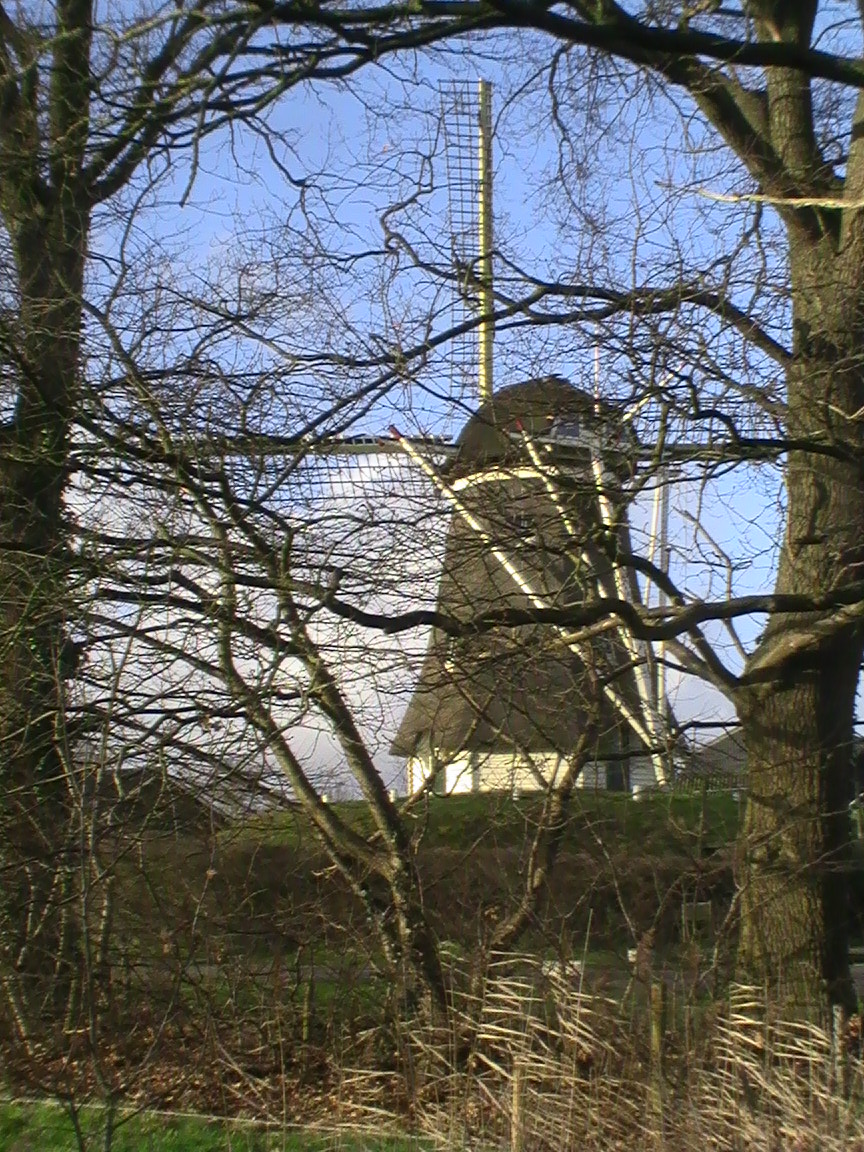
Some typical scenes taken from the middle of Holland.